
Back in the day, our forefathers did a pretty good job of anticipating many of the stupid things our leaders might attempt at one time or another. They wrote a document (the Constitution?) that basically says, “you guys” (Congress) make the laws, and “you” (the president) enforce the laws, and “you guys” (The Supreme Court) settle all disputes involving those other two guys.

This past week, the Supreme Court did just that, ruling that in 2025 President Trump went a bit beyond his job description when imposing some of his tariffs. Under the Constitution, Congress largely controls tariff policy. While presidents do have a few ways to impose tariffs on their own, the Court said Trump stretched those powers too far.
The tariffs in question were imposed under the International Emergency Economic Powers Act (IEEPA), which allows the president to impose certain tariffs during a national emergency involving any “unusual and extraordinary threat.” Trump claimed that long-standing trade deficits (Americans buying more stuff from foreign countries) and foreign economic practices (other countries subsidizing their industries, copying technology, etc.) amounted to such a threat. But those conditions have been part of the normal ebb and flow of global trade for decades, thus, not exactly a sudden emergency.
Donald Trump pushing the boundaries is nothing new and maybe not all that interesting. But what is interesting are the questions concerning the roughly $130 billion in IEEPA tariffs that our government collected from businesses last year. Will the government pay this back? With interest or penalties? When? Is that easy to determine? Who is going to track all of this? Are there strings attached? And, oh, by the way, if a company passed the cost of tariffs on to their customers, didn’t the customers pay the tariffs?
So many questions!
It appears SCOTUS must have felt the same, because it didn’t provide any ruling regarding repayment, simply punting the issue back to the lower courts.
Several months ago, we discussed how Costco had sued the U.S. government, essentially to get first in line for potential refunds. And so far it sounds like suing the government is the only way to recoup those funds. We expect this mess to take months, if not years, to untangle.
Tariffs are a central part of Trump’s economic agenda, and the IEEPA tariffs accounted for roughly half of all tariff revenue collected last year. Now that they are gone, what’s next?
Well, as expected, the Trump team quickly shifted to other mechanisms to continue to assert pressure on trading partners. These mechanisms are potentially less controversial fixes (but not without their gray areas) to get around Congress, one of which was instantly deployed in the hours following the Supreme Court ruling. However, this fix doesn’t allow the President to tailor his tariffs to specific countries, and there is a 150-day deadline before Congress can cut them off.
Trump has a couple additional ways to flex his tariff muscle without congressional approval, but they aren’t quite so immediate. They require investigations and paperwork and processing, determining that certain sectors of the economy are national security concerns, or that other countries are engaging in unfair trade practices. They take months to implement. We don’t expect this to stop Trump from pursuing his economic plan, but it does mean that a quick Tweet, Truth Social post, or emergency press conference won’t be enough. The process now must run through the slower, legal channels our forefathers put in place.
We’ve been saying for years that the price you pay for a stock matters. That can be easy to forget when a handful of stocks drive the indexes higher and valuations continue climbing to levels that seem hard to justify.
But what we’ve seen so far this year has served as a reminder that fundamentals and valuation still do matter. The broader S&P 500 has been flat year to date, while the software component of that index is getting crushed, down almost 23%!
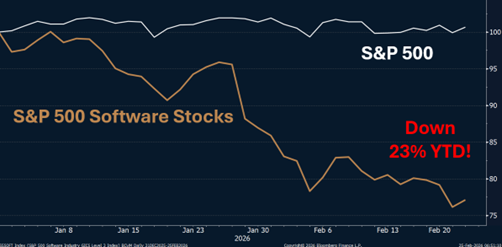
Driving the selloff in software names has been the market’s realization that advances in artificial intelligence could upend the business models and future growth prospects of many of these companies, for example Workday (WDAY), which makes money selling subscriptions of its software, helping large organizations hire and manage employees. Workday grows when companies add staff and purchase new licenses for their software. New AI tools could allow companies to do more with less people (fewer licenses) and automate many of those administrative tasks, taking a huge bite out of the recurring revenue for such businesses.
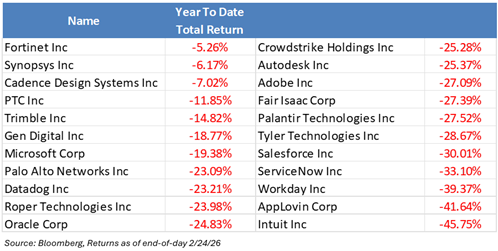
Here are all the “software” companies in the S&P 500 and their performance year to date:
Meanwhile, “value stocks,” that are typically boring, have not been boring at all this year. These are companies that make everyday products and transport those products across the country. Many of them are up double digits this year including names such as Union Pacific Railroad and Stanley Black & Decker.
Value stocks have a history of outperforming their “growth stock” counterparts in the long run, but that hasn’t been the case the last couple of decades. Perhaps the tide has turned.
This information is provided for general information purposes only and should not be construed as investment, tax, or legal advice. Past performance of any market results is no assurance of future performance. The information contained herein has been obtained from sources deemed reliable but is not guaranteed.