
For much of the past 15 years, borrowing money was practically free. Homeowners locked in mortgages as low as 2% and 3%, businesses borrowed at historically low rates, and the U.S. government accumulated trillions of dollars in debt.
It was a pretty good arrangement . . . while it lasted.
Earlier this month, the yield on the 10-year U.S. Treasury reached 5.34%, its highest level since 2002. That was back when George W. Bush was president, the dot-com bubble had just burst, and Americans were still renting DVDs from Blockbuster.
For many Americans, today’s interest rates feel painfully high. But a little perspective might be in order.
There was a time when a 12% mortgage was considered a pretty good deal.
Seriously.
Ask anyone who bought a house in the early 1980s. Mortgage rates were pushing 16%, inflation was running in double digits, and you could earn nearly 18% just by parking your money in a money market fund.
We’ve spent so long in a world of historically low interest rates that investors seem to have forgotten what anything else looks like.
So why are interest rates rising? We have a few reasons . . . some are old (and maybe a little tired), and some are new. But they are all impactful.
Too Much Debt, Too Little Discipline
Excessive debt can rear its ugly head in a number of ways. History has shown that countries burdened by too much debt (think Japan in the late ‘80s) are eventually doomed to suffer a period of sluggish economic growth, which puts downward pressure on inflation and interest rates.
However, excessive debt creates risk, and risk spooks investors. If investors get concerned about the government’s ability to pay them back, they may sell the bonds . . . which pushes bond prices down and interest rates UP.
Imagine a major developed country that has spent decades spending more money than it collects in taxes. Its national debt continues to grow, interest payments are consuming an increasingly large share of its budget, and politicians seem incapable of agreeing on how to fix the problem.
Sound familiar?
You might assume we’re talking about the United States. But we’re actually talking about France.
France offers a cautionary tale of what can happen when governments put off difficult financial decisions for too long. Years of persistent deficits and sluggish economic growth have left the country with few easy options. Efforts to rein in spending have met with protests, strikes, and riots. Meanwhile, investors are growing increasingly concerned. French 10-year government bond yields have recently climbed above those of Greece, once the poster child for fiscal mismanagement and the recipient of an international bailout just 15 years ago.
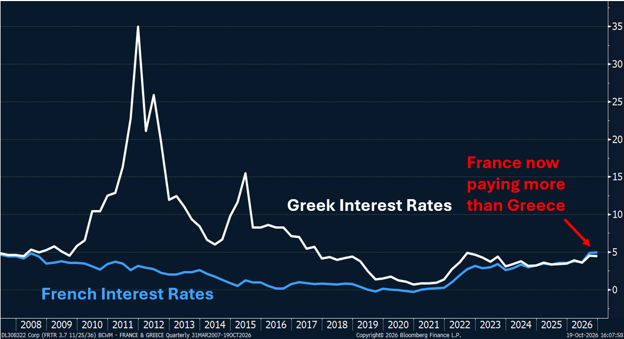
France’s financial situation has deteriorated rather quickly, and it may be the canary in the coal mine for other heavily indebted countries. Government borrowing costs have been rising across much of the developed world, including the United States.
The problem is simple. Governments need to borrow enormous amounts of money, and when the supply of bonds grows faster than investors’ willingness to buy them, interest rates must rise to attract buyers.
The U.S. has one significant advantage: the dollar’s status as the world’s primary reserve currency creates substantial global demand for Treasury securities. But that doesn’t mean we can borrow indefinitely without consequences.
Artificial Intelligence Has an Expensive Price Tag
Governments aren’t the only borrowers competing for investors’ money.
Companies like Microsoft, Amazon, Alphabet, and Meta are pouring hundreds of billions of dollars into the infrastructure needed to support artificial intelligence. And increasingly, they’re borrowing money to do it.
Consider Meta. For years, the company generated enough cash to invest heavily in its business and still return billions to shareholders. But AI has changed that equation. Spending has surged, and Meta is now expected to borrow approximately $36 billion in 2026 to help finance its expansion.
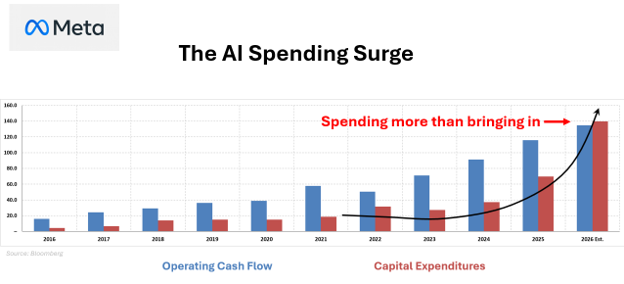
And that’s just one company.
Vanguard estimates that AI-related companies could issue between $300 billion and $570 billion in new debt this year.
Why does this matter? Investors looking for relatively safe bonds have options. They can lend money to the U.S. government or to financially strong companies. Companies typically offer higher interest rates to attract buyers. And as more companies compete for those same investment dollars, the government may have to offer higher yields to keep up.
In other words, the AI boom may be crowding out some demand for U.S. Treasuries.
Inflation: The Elephant in the Room
Perhaps the most important reason interest rates have remained elevated is inflation.
After moderating into the mid-2% range to start the year, inflation has accelerated to 3.7%, driven largely by higher energy prices.
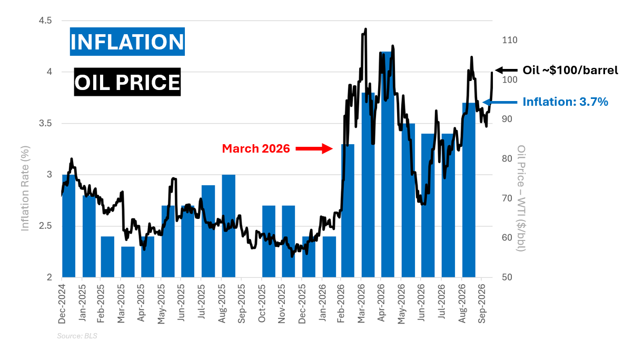
The war with Iran has pushed oil prices from roughly $60 per barrel to $100 per barrel. This has been the case for months. We all know why . . . oil is stuck in the Persian Gulf. It can’t get through the Strait of Hormuz, right?
Well, not exactly. Middle Eastern oil exports have not only recovered to prewar levels but now exceed them thanks to alternative pipelines and some creative shipping arrangements. That’s right – more oil is coming out of the Middle East than before the war.
So why are prices still so high?
Because getting oil out of the region and getting it efficiently to where it’s needed are two very different things.
Tankers are taking longer routes, shipping costs have skyrocketed, and global supply chains have become increasingly inefficient. One recent report estimated that transporting oil from the United States to Japan could cost $81 million for a single voyage, compared with approximately $9 million last year.
That’s more than the cost of launching a SpaceX Falcon 9 rocket into space.
In addition to coping with high oil prices, economies around the world are struggling with record-high diesel fuel prices. Diesel is a big deal. It is the primary way that high oil prices make their way into the cost of what we spend money on.
Look around your house, nearly everything you see was transported there by truck or train that runs on diesel. The agricultural equipment that grows and harvests our food runs on diesel. So does the heavy machinery used to build our homes and buildings.
When diesel prices rise, the cost of virtually everything we consume eventually feels the impact.
Diesel is refined from oil, so higher oil prices naturally push up diesel costs. Making matters worse, Russia and the Middle East are major exporters of diesel, and both regions have experienced significant war-related disruptions to their refining operations. Other refineries around the world haven’t been able to make up the difference, adding another layer of upward pressure on diesel prices.
Perhaps most concerning is what the oil futures market is telling us. Earlier this year, investors anticipated oil prices would decline relatively quickly as supply disruptions eased. Today, futures prices suggest oil could remain elevated considerably longer than previously expected.
That doesn’t guarantee higher inflation. But it does suggest inflationary pressures may prove more persistent than investors had hoped.
And persistent inflation makes it difficult for interest rates to fall.
What If Higher Rates Are Here to Stay?
Well, the upside is that bond investments should provide a better return going forward. For the first time in years, investors could earn more than 5% on a 10-year U.S. Treasury bond. That changes the appeal of stocks, particularly those trading at lofty valuations.
When investors can earn attractive returns from relatively safe investments, they’re less willing to pay extraordinary prices for stocks. And while AI may transform the economy, there’s a difference between a great business and a great investment.
At BCWM, we’ve been making some deliberate adjustments.
We’ve trimmed positions in companies whose valuations have become increasingly expensive, which may make our clients’ tax bills a little higher this year. We’ve continued finding opportunities in what we affectionately call “boring value” stocks, which we believe offer a more attractive balance of risk and reward.
And with Treasury yields recently exceeding 5%, we’ve increased our exposure to bonds, locking in attractive income while adding stability to portfolios.
We don’t know whether interest rates have peaked, when inflation will subside, or when the next market disruption will arrive.
Fortunately, we don’t have to know.
Our job isn’t to predict the future with perfect accuracy. It’s to recognize where the risks are, identify where we’re being adequately compensated for taking them, and build portfolios capable of navigating whatever comes next.
And in a world where investors can finally get paid a meaningful return for taking less risk, we think that’s a pretty good place to be.
This information is provided for general information purposes only and should not be construed as investment, tax, or legal advice. Past performance of any market results is no assurance of future performance. The information contained herein has been obtained from sources deemed reliable but is not guaranteed.