
Last weekend, CBS Sunday Morning ran a piece on the growing popularity of prediction markets. They spotlighted Kalshi, a platform where you can now trade contracts on everything from Fed rate decisions to whether Kylie Kelce or Blake Lively will be a bridesmaid when Taylor Swift finally ties the knot. That’s a lighthearted example, but it captures something real: we’ve entered an era where literally anything with an uncertain outcome can be turned into a tradable financial instrument.
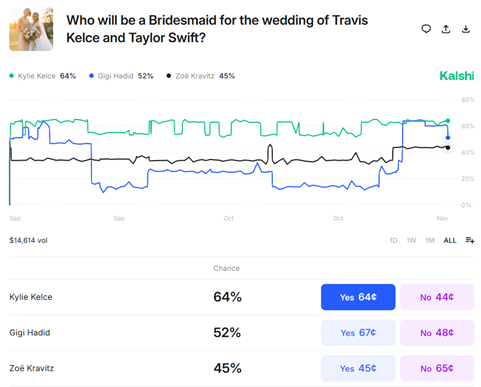
Here’s how it works. Each event is structured as a binary yes/no contract that settles at $1 if the outcome happens and $0 if it doesn’t. The price you see at any moment (64 cents on “Kylie Kelce makes the bridal party”) is the market’s collective probability. Because real money is on the line, participants have skin in the game, and these markets can sometimes lead to forecasts that track outcomes more closely than traditional polling. In 2024, Kalshi and its main competitor, Polymarket, gave Donald Trump far higher odds than most media outlets did in the final weeks of the presidential race.
And earlier this year, they crossed another boundary and began offering sports contracts. What started as a platform for trading inflation announcements and election outcomes suddenly included markets on who would win the game on Sunday. Neither company calls this “sports betting,” but functionally, it looks rather similar.
The reason these platforms can operate nationwide, unlike FanDuel or DraftKings (which are still illegal in eleven states), rests in a clever regulatory jiu-jitsu. By registering with the Commodity Futures Trading Commission (CFTC) instead of state gaming commissions, companies like Kalshi argue they’re operating futures markets on events, not placing bets.
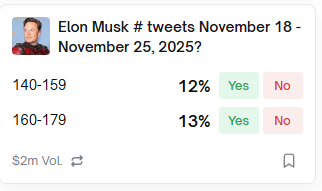
But futures markets were created as a tool for managing risk, not as a form of gambling. They were introduced in the 1800s to allow farmers to lock in prices before harvest, not to predict how many times Elon Musk will tweet before Thanksgiving.
And yet, the company that did more than any other to turn personal investing into a smartphone game is now the biggest gateway to these markets. Robinhood, the app that became the on-ramp for a generation of first-time stock pickers (complete with zero-commission trades, confetti explosions, and meme-stock manias) has quietly rolled out a full prediction-markets hub. Through a partnership with Kalshi, its users (who skew young and male) can now trade “Will the Kansas City Chiefs cover -3.5 tonight?” with the exact same swipe they use to buy Tesla or Bitcoin (which has dropped 34% since October 7).
Make no mistake: sports now dominate the volume. While Kalshi and Robinhood still offer contracts on inflation, Oscar winners, and SpaceX launch dates, industry estimates put sports-related event contracts at roughly 75–80% of total notional trading volume. In other words, we took a 19th-century agricultural risk-management tool, called it a “futures contract,” and quietly turned it into the most accessible sports-betting platform in America.
- A decade ago, the line was clear:
- Investing was buying shares in a company you believed would grow over years.
- Gambling was putting $50 on black at the casino or on a Sunday parlay.
Today that line has vanished. Your portfolio screen now sits next to live NFL spreads. Your push notification about Apple earnings arrives seconds before one that says, “Your Lakers contract is up 312%.”
For an entire generation, the psychological boundary between investing and gambling no longer exists. As investment managers, this means more opportunities to find mis-priced securities. As financial advisors, this means our work assisting the next generation of clients to build wealth includes also helping to rewire their brains to think in decades instead of quarters . . . or even quarters of football.
And, oh, by the way, if investing/gambling begins to become an addictive problem for you, dial 1-888-BETSOFF . . . or let BCWM manage your investments for you.
The federal government officially reopened on November 12. The 43-day shutdown was the longest in our nation’s history. The deal between Democrats and Republicans merely kicked the fight to January 31, a short-lived truce in a long-running partisan standoff.
Aside from a couple of days of flight disruptions, short delays in food-assistance processing, and missed paychecks for roughly two million federal workers, the vast majority of Americans felt no impact on their day-to-day lives.
A relatively minor inconvenience to our profession was the disruption of economic data. The shutdown severely halted the release of the key numbers we rely on to make decisions. Figures on inflation, jobs, GDP, consumer spending – all those nerdy econ metrics – suddenly went dark.
Not all economic statistics come from government agencies. And during this blackout, a host of worrisome reports emerged from private-sector sources.
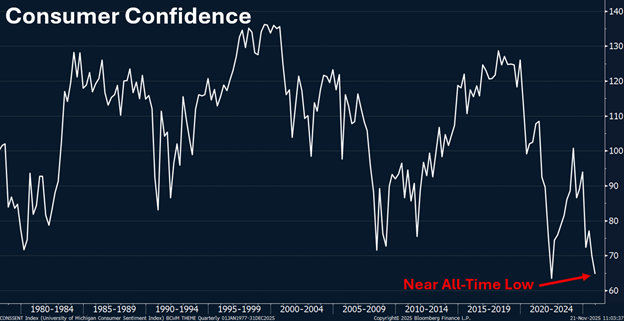
For starters, consumer confidence (measured by the University of Michigan’s Consumer Sentiment Index) is near its lowest measure on record. This “soft” data tells us how consumers feel, and therefore indicates how they may act and what that may mean for the economy.
Also, Challenger, Gray, & Christmas, a staffing firm that’s a recognized leader in tracking job layoffs, reported that October 2025 was the worst October in terms of layoffs in 20+ years (perhaps leading to that weak Consumer Sentiment number . . . not having a job can do that to you). Typically, in the fall, firms are busy gearing up for the holiday season, so the spike in layoffs raised some eyebrows. A portion of the announced layoffs are being driven by AI and automation – companies are cutting roles they think AI can replace or streamline. However, cost-cutting measures and weak demand are strong drivers as well.
Lastly, it seems as though inflation could be picking up. Jeffrey Schmid, president of the Federal Reserve Bank of Kansas City, said it appears that inflation is running “in the 3 percent range” and that it is “spreading across categories, both goods and services,” noting that it is not just related to tariffs.
The Federal Reserve has been trying to strike the right balance setting interest rates – higher rates keep a lid on inflation but may stymie the job market, lower rates may support the job market but allow inflation to run hot. It too has been flying blind without economic data.
Now data is starting to return. The danger for investors is that it could expose an economy that looks far weaker than it did before the blackout – potentially delivering a shock to the stock market.
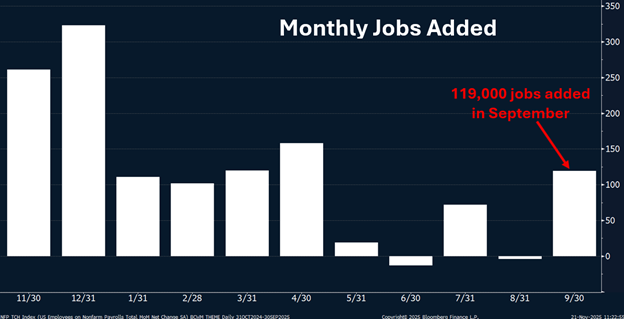
Fortunately, on Thursday we finally got a reading on how the job market looked in September (two months ago): the economy added 119,000 jobs, a welcome sign after a string of weak reports.
And as more data flows in, the picture will continue to clear up. Government shutdown or not, we were still managing portfolios. While stocks were hitting all-time highs last month, we were trimming positions, taking profits and reducing risk in the face of frothy valuations.
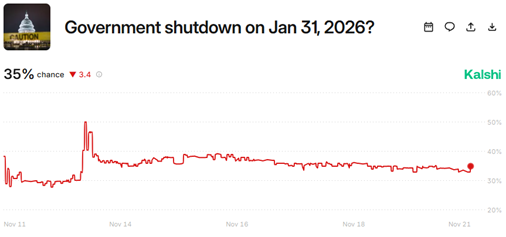
Curious note . . . when the government closed on September 30, it was referred to as a SHUTDOWN. Does that mean when it reopened on November 12, we should refer to it as a SHUT-UP? Prediction markets currently place the odds of another government shutdown on January 31 at roughly 35%.
Shutdown or shut-up, rest assured that BCWM will continue to manage your portfolio as we always have.
This information is provided for general information purposes only and should not be construed as investment, tax, or legal advice. Past performance of any market results is no assurance of future performance. The information contained herein has been obtained from sources deemed reliable but is not guaranteed.