
Every major technological shift creates something new.
The internet made information nearly free and instantaneous. Smartphones put that information into our pockets. Social media gave everyone a megaphone.
And now artificial intelligence (AI) is making content nearly limitless . . . whether the content is true or not.
Spend a few minutes scrolling through X (formerly Twitter), Facebook, Instagram, or TikTok and you’ll quickly find videos that look authentic but never actually happened. Some are harmless and hilarious. Others are intentionally misleading and horrifying.
And it’s only getting better (worse?).
Today, almost anyone can create a realistic – but fake – video, photograph, article, podcast, or even a convincing voice recording with little more than a simple prompt. As AI makes information cheaper and easier to produce, one question matters more than ever:
Can I trust it?
We believe that question won’t just reshape social media. It will reshape wealth management as well.
At BCWM, we already use AI to help us work more efficiently, analyze information more quickly, communicate more clearly, and, ultimately, provide a better client experience.
We believe AI will make good advisors better. It will not make advisors obsolete.
Because while AI can process information, it can’t build relationships.
It can learn facts about you but will never truly know you . . . or your family.
It won’t notice the hesitation in your voice when you say you’re “fine” with retiring next year.
It won’t be on the other end of that phone line when markets get extremely volatile and you need to hear a voice . . . an empathetic yet knowledgeable voice.
It won’t attend your funeral . . . or even care that you died.
You will never get compassion from a memory chip.
Artificial intelligence can generate answers. But it cannot exercise wisdom. It cannot earn trust. And it cannot genuinely care about the outcome.
In the age of AI, trust and human relationships may become the most valuable commodities of all.
The same principle applies to investing. Just as AI-generated information requires discernment, so do AI-related investments. We can be incredibly optimistic about the technology and yet remain disciplined about the prices investors are paying for it.
Over the past several weeks, investors have become a bit more selective. Many of the largest AI-related stocks have pulled back meaningfully, while value-oriented companies have quietly outperformed. There are several reasons for the recent caution.
Spending Exceeding Cash Flows
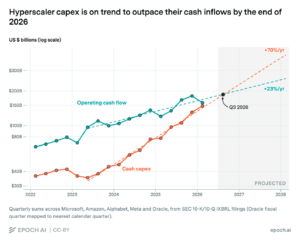
In recent history, hyperscalers (the giant companies behind much of the world’s cloud computing, including Microsoft, Amazon, Alphabet, and Meta) have generated enormous amounts of cash, giving them the financial flexibility to invest aggressively while still returning capital to shareholders.
The cost of the initial AI buildout is changing that. Spending on data centers, AI chips, and other infrastructure (known as capital expenditures, or “capex”) has accelerated so rapidly that cash balances are under increasing pressure. Although these companies continue to generate enormous operating cash flows, much more of that cash is now being spent on the AI buildout (capex) rather than being returned to shareholders. In some cases, companies may increasingly rely on debt or other forms of financing to maintain both aggressive AI investment and shareholder returns.
“Circular Financing”
Another concern regarding the AI world is what some investors are calling “circular financing.” Funding for much of today’s AI boom comes not only from companies selling products and services to one another but, in some cases, from companies that help finance the purchases that ultimately drive demand for their own products. The concern isn’t that these transactions are inappropriate, but, rather, that they can make demand appear stronger during a rapid expansion.
Think of it like a car dealership that helps customers finance the purchase of its own vehicles. The sales are real, but some of the demand exists because the dealership made it easier to buy the cars. If customers repay their loans and keep buying vehicles, everyone wins. But if demand weakens or buyers can’t repay their loans, the dealership is hit twice: it sells fewer cars and it faces losses on the financing it provided.
NVIDIA is reportedly in talks to provide financing guarantees of more than $750 billion in AI-related deals to help customers build data centers (thereby selling billions of dollars of NVIDIA chips in the process). These arrangements can accelerate adoption of AI, but they exacerbate the downside if overall demand does not meet expectations.
Global Competition
Finally, there’s the risk of competition. Investors have largely assumed today’s AI leaders will remain tomorrow’s winners, but history suggests technological leadership rarely goes unchallenged. Most recently, Moonshot AI, a Chinese startup, has produced an AI model that measures on par with U.S. leading models, but at about half the cost (allegedly).
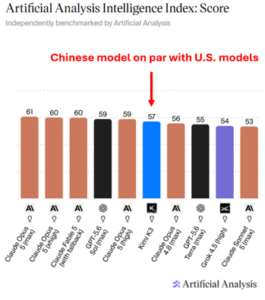
Intense competition is a good thing for the industry but will likely make it harder for any single company to earn the outsized profits investors currently expect.
None of these concerns suggests AI won’t reshape the world as we know it. They simply remind us that revolutionary technologies don’t always produce the obvious winners of said technologies right at the outset, and investors need to be careful about where they place their bets. The difficulty doesn’t lie in predicting whether AI will change the world. The difficulty lies in predicting who will make the most money from it – over the next decade and beyond.
The ongoing war in Iran continues to be a major driver of the economic- and investment landscape. From our perspective, the situation is extremely complicated yet painfully simple.
It is complicated because . . . well . . . it is a war. People have lost their lives. Even those spared the immediate threat of physical harm have had their daily lives severely disrupted. And the effects extend far beyond the battlefield. Businesses have been interrupted, supply chains have been strained, and disruptions in the Strait of Hormuz have had far-reaching consequences around the world.
There are legitimate arguments supporting U.S. involvement. Iran’s nuclear ambitions can be viewed as an unacceptable threat. Furthermore, destroying certain military capabilities and weakening the country’s support of terrorist groups may be necessary to promote longer-term stability.
At the same time, Trump campaigned heavily on “no new wars,” and the escalating military action in the region can be viewed as unnecessary, perhaps provoking retaliation that might not otherwise have occurred. Some of the death and disruption now taking place may have been avoidable.
It is complicated.
But our job is to remain agnostic and manage our clients’ money. From that perspective, the situation is painfully simple.
The best path forward for all parties, and for the global economy, is peace, whatever form it ultimately takes. Iran needs the revenue generated by its oil exports, while the rest of the world needs reliable energy supplies and functioning trade routes. History has shown that peace will not be everlasting, but a truce can be enough to allow the Strait of Hormuz to fully reopen and business activity to return to normal.
We don’t have a crystal ball to know when that will happen, but for the markets, peace is good and war is bad.
Since stock markets incorporate long-term expectations about the future, they are often easily able to look past the terrible things that can happen around the world. The war in Iran brought some volatility, but eventually stock prices continued upward, hitting new all-time highs. The stock market sees some workable version of peace as inevitable.
Bond markets are driven by interest rates . . . which are heavily driven by inflation . . . which is heavily influenced by oil prices . . . which swing sharply one direction or another based on activity in the Strait of Hormuz.
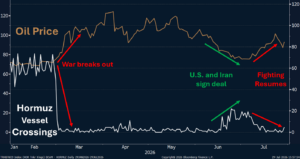
Even if the analysis is painfully simple, from an investment perspective, the war matters a lot. We’re hopeful that some deal will be struck and the fighting subsides enough that the oil starts flowing again. When that happens, we expect lower interest rates and higher bond prices to result. Until then, we expect continued volatility.
And if this war gets ugly, take comfort knowing that our approach to risk management – owning safe bonds and properly valued assets that deliver cash flow – is positioned well to weather the storm.
Trust us.
This information is provided for general information purposes only and should not be construed as investment, tax, or legal advice. Past performance of any market results is no assurance of future performance. The information contained herein has been obtained from sources deemed reliable but is not guaranteed.