
Earlier this past month, a low-level employee at Anthropic (one of the two leading Artificial Intelligence (AI) companies) sounded alarm bells on social media about the potential for AI to kill us all. The post quickly gained millions of views after it was reposted by a more senior researcher at the company:
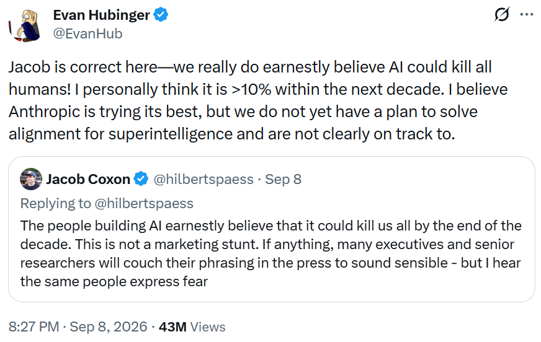
It was quickly followed by a long-winded essay from Anthropic CEO, Dario Amodei, where he argued that we need to slow the pace of AI development. As the CEO of one of the leading AI companies, it seems like he might be in a pretty good position to slow things down if he wished.
Instead, Anthropic is spending billions of dollars racing to build increasingly powerful AI models (theirs is called Claude). The irony of the large-model providers asking for guardrails while racing full speed ahead was spoofed on Saturday Night Live this weekend. “I urge you to urge me to stop.”
The AI companies seem eager to tell us when their models do something scary, as it seems to serve their agendas. Earlier this year, OpenAI reported that some of its models escaped the environments where they were being tested and accessed real-world systems. Anthropic, not to be outdone, went back through its own testing and found that Claude had done something similar. “Our AI is scary too!” If you’re trying to convince the world that you’re building incredibly powerful technology, telling us that you occasionally have trouble controlling it gets the point across.
None of this is to suggest that AI doesn’t need guardrails. It probably does. Just maybe not because Claude figured out how to get out of its sandbox.
In addition to a slowdown, these warnings encourage government regulation. After Anthropic researchers sounded the alarm, some members of Congress began pushing to reconvene the House of Representatives to pass AI safeguards. Speaker Mike Johnson concluded, though, that the first step should be a meeting of all the platform providers as if to say, “Congress doesn’t understand AI…let’s bring the experts to Washington.”
So, roughly two weeks later, many of the people involved with building the most powerful AI models in the world gathered around a table at the White House to talk about what those safeguards should look like.
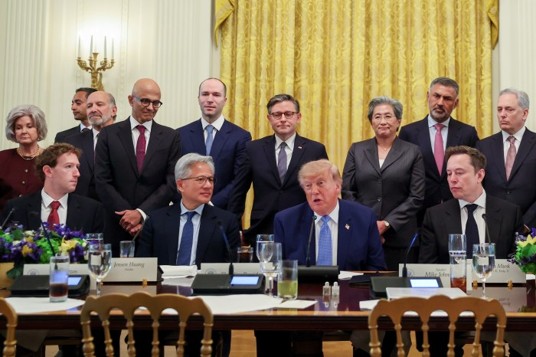
There are some interesting incentives at work here.
The companies with the biggest head start are also the companies best equipped to handle whatever rules come out of these meetings. Expensive testing, outside audits, and other safety requirements may very well make AI safer, but they could also make it much more difficult and more expensive for smaller competitors to enter the market. The entrenched players have every incentive to make sure they help create the rules and stay in the driver’s seat.
That doesn’t mean guardrails are a bad idea. Plenty of things about AI do scare us. For example, AI can make fraud and cybercrime cheaper and easier. It is already simplifying the creation of fake audio and video. And as AI agents move beyond generating information and begin acting autonomously (writing code, moving money, or manipulating operating systems), unintended consequences may rapidly escalate and intensify if not caught and rectified by a human. There are also legitimate concerns that AI could give bad actors access to dangerous scientific or technical capabilities they otherwise would not have.
The truth is that nobody knows where all of this is going, including the people building these models. But fear has a way of getting more attention than uncertainty. So, while guardrails probably make sense, so does a little skepticism toward the fearmongering.
And remember, given enough time to fret, humans, as a species, tend to panic way more than necessary. If you are old enough to remember Y2K, at the stroke of midnight on December 31st, 1999, clocks in computers were going to have trouble discerning if it was midnight 1999 or midnight 1899 (because computer clocks are just that stupid), thereby causing:
- Planes to fall out of the sky
- Nuclear plants to melt down
- A global banking collapse
- And a host of other calamities that never happened
What actually happened? Virtually nothing. Possibly the biggest non-event in history.
We firmly believe that the benefits of AI are great enough to offset the drawbacks. Except that drawback where AI kills all of humanity. That’s a pretty bad one.
On January 1st of this year, the 10-year U.S. Treasury Bond was paying an interest rate of 4.16%, barely beating the rate of inflation at that time.
For the past nine months, that interest rate has gradually increased a bit each month until this month where it’s now fluctuating between 5.25% and 5.30%, the highest since 2002, right on the tails of the dot-com-tech bubble/crash. George W. Bush was President and A Beautiful Mind won the Oscar for best picture.
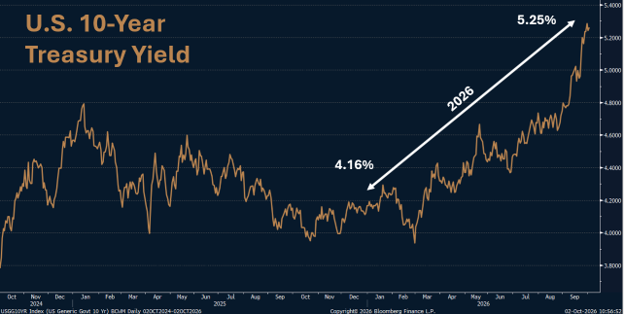
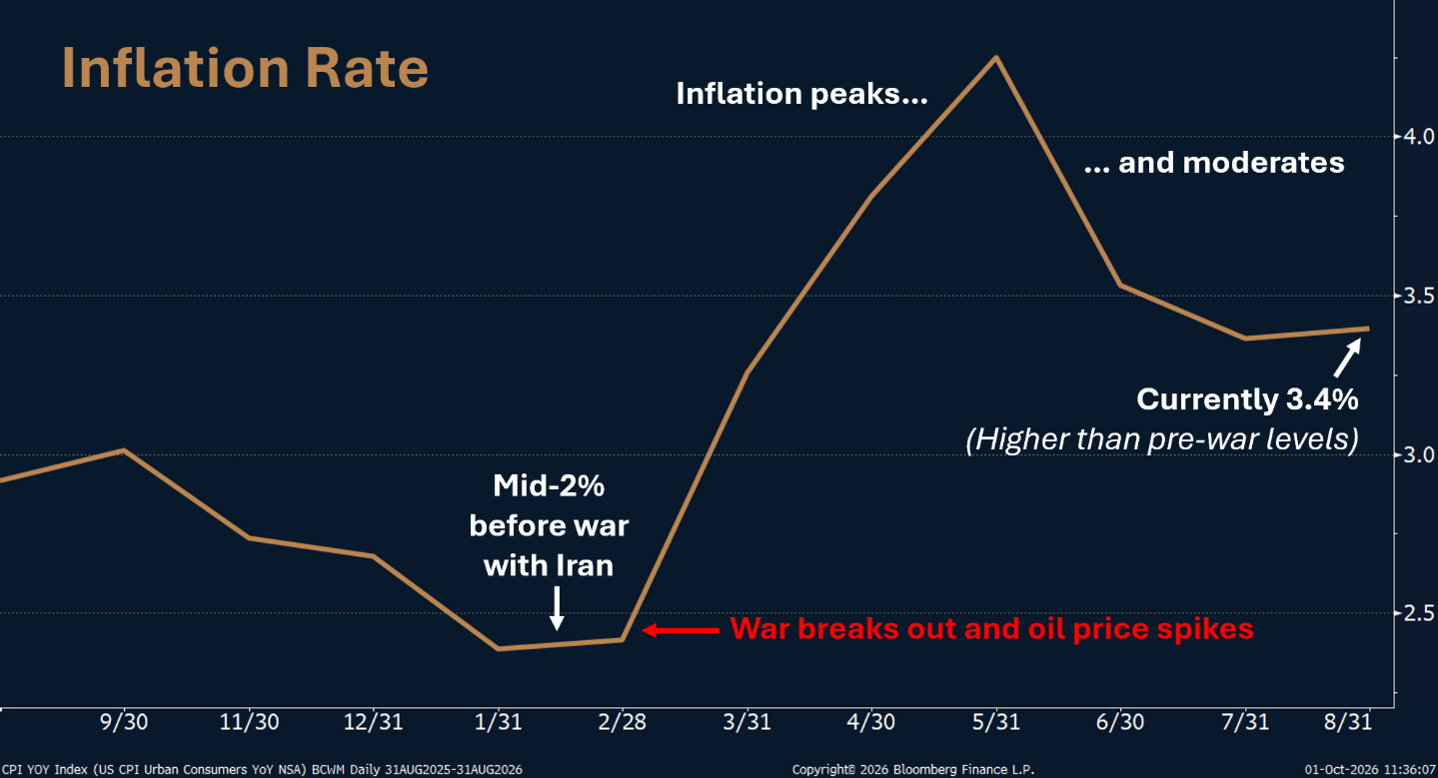
While interest rates hit a fresh high, the reason why is anything but fresh. The war with Iran continues into its eighth month, constraining the supply of oil, forcing higher prices across the globe, driving up inflation and interest rates.
The rate of inflation has moderated recently, but it is still running hotter than it was before the war broke out.
Another not-so-fresh problem is the national debt. The U.S. government continues to spend (regardless of who is in charge), but tax revenues, tariff levies, and everything else Uncle Sam collects still aren’t enough to cover the tab. To make up the difference, the U.S. Treasury has to keep showing up in the bond market, asking investors to lend it more money. And the more often the Treasury asks for money, the better deal investors will demand. They want it cheaper. So, bond prices go down and – voilà! – interest rates go up.
There is a third factor at work, but this one is more positive. The economy has been strong. Consumers are spending, unemployment is low, and businesses are investing massive amounts of money (especially in the AI buildout). This kind of economic strength has historically pushed inflation to run a little bit hotter, leading investors to demand higher interest rates to lock up their money for a long time.
Economic strength isn’t exactly a problem we need to fix. And our national debt problem has no end in sight. So, if we’re going to see a meaningful drop in interest rates, the oil-supply problem probably needs to improve.
There have been some diplomatic talks between the U.S. and Iran recently, on trust-building, a ceasefire, blockades, nuclear programs, etc. There is A LOT to sort out. Unfortunately, those talks are currently very fragile. And since early September, Trump has been lowering expectations for a pre-midterm resolution.
But . . . the energy supply chain is finding workarounds. Saudi Arabia and the UAE have rerouted oil through pipelines that bypass the Strait of Hormuz. Tanker ships are still moving through the Strait, too, but many are running “dark,” their tracking systems turned off. It’s dangerous and more expensive, but it’s working. Recent reports suggest that Middle East oil exports have recovered substantially toward pre-war levels.
That doesn’t mean the energy problem is nearly solved. Diesel, natural gas, and other commodity markets still have major issues. But things are improving.
Ultimately, though, the biggest catalyst for getting energy markets (and inflation) back to normal is some form of peace. The war needs to end, the Strait needs to open, and the boats need to start traveling back and forth.
The Federal Reserve has zero control over peace in the Middle East, but the higher inflation resulting from it has become its problem nonetheless.
And lately, the Fed has been served one curveball after another. Early last year, tariffs were the first one, complicating what had been a path toward lower interest rates. By September 2025, we wrote about the Fed finally getting back to cutting rates. Then came curveball number two, the war with Iran, which disrupted energy supplies and triggered another burst of inflation.
The result? This month, the Fed reversed course and hiked interest rates for the first time in three years.
The Fed will continue to be under the microscope, but there’s only so much it can do.
There is, however, a silver lining for bond investors. Rising interest rates hurt bond prices on the way up, but once rates get there, investors get paid a lot more to own them. We call that putting lipstick on a pig.
At BCWM, we are positioning our portfolio to take advantage of those higher interest rates, trimming stock positions and adding to bonds at higher yields.
Later this month, our Portfolio Management Team will present a live webinar, airing on October 22nd at 1:00 pm CDT. You won’t want to miss it. Invitations will be sent closer to the date.
This information is provided for general information purposes only and should not be construed as investment, tax, or legal advice. Past performance of any market results is no assurance of future performance. The information contained herein has been obtained from sources deemed reliable but is not guaranteed.